
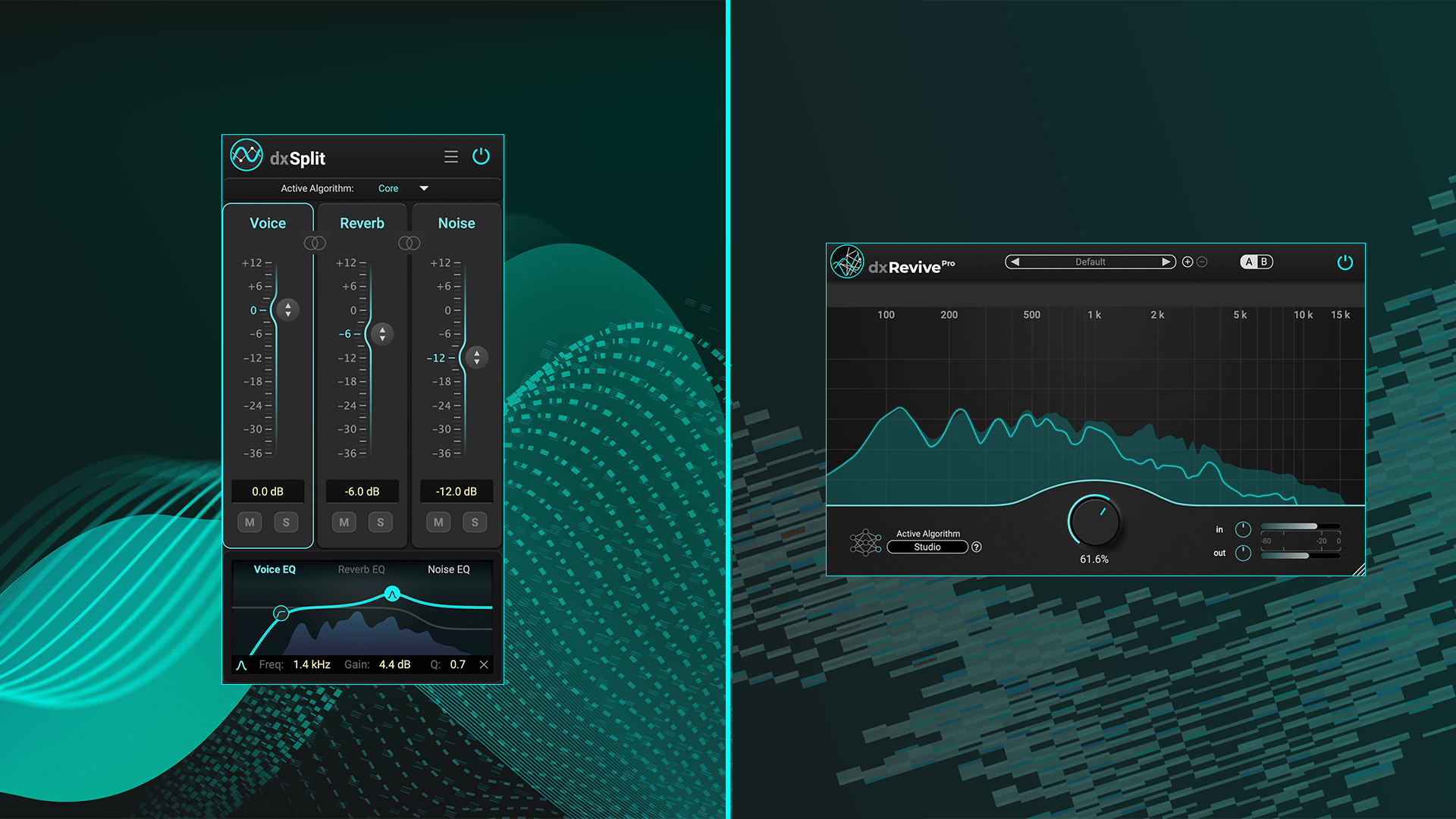
In our article on the evolution of speech enhancement, we outlined how audio restoration techniques can be broadly grouped into three stages — from classical signal processing to statistical models and modern deep learning approaches. But what does that actually mean for tools like dxSplit and dxRevive?
While both are designed to improve dialogue recordings, they take fundamentally different approaches. dxSplit focuses on cleaning dialogue of its background noise — while dxRevive uses re-synthesis to complete missing pieces. In this article, we break down the difference and explain when to use each.
The 3 Stages of Speech Enhancement
From a historical view, speech enhancement techniques can be stacked up into three stages:
1. Filtering based on a Noise Profile
2. Neural Network powered Filters
3. Neural Network based Re-Synthesis
Most modern tools can be loosely mapped onto these categories — although many systems today combine elements from multiple stages.
What this classification means
While this three-stage model is useful historically, it also captures how modern audio tools differ: Today, the key distinction is no longer just how noise is removed — but whether the system enhances the original signal or reconstructs it entirely.
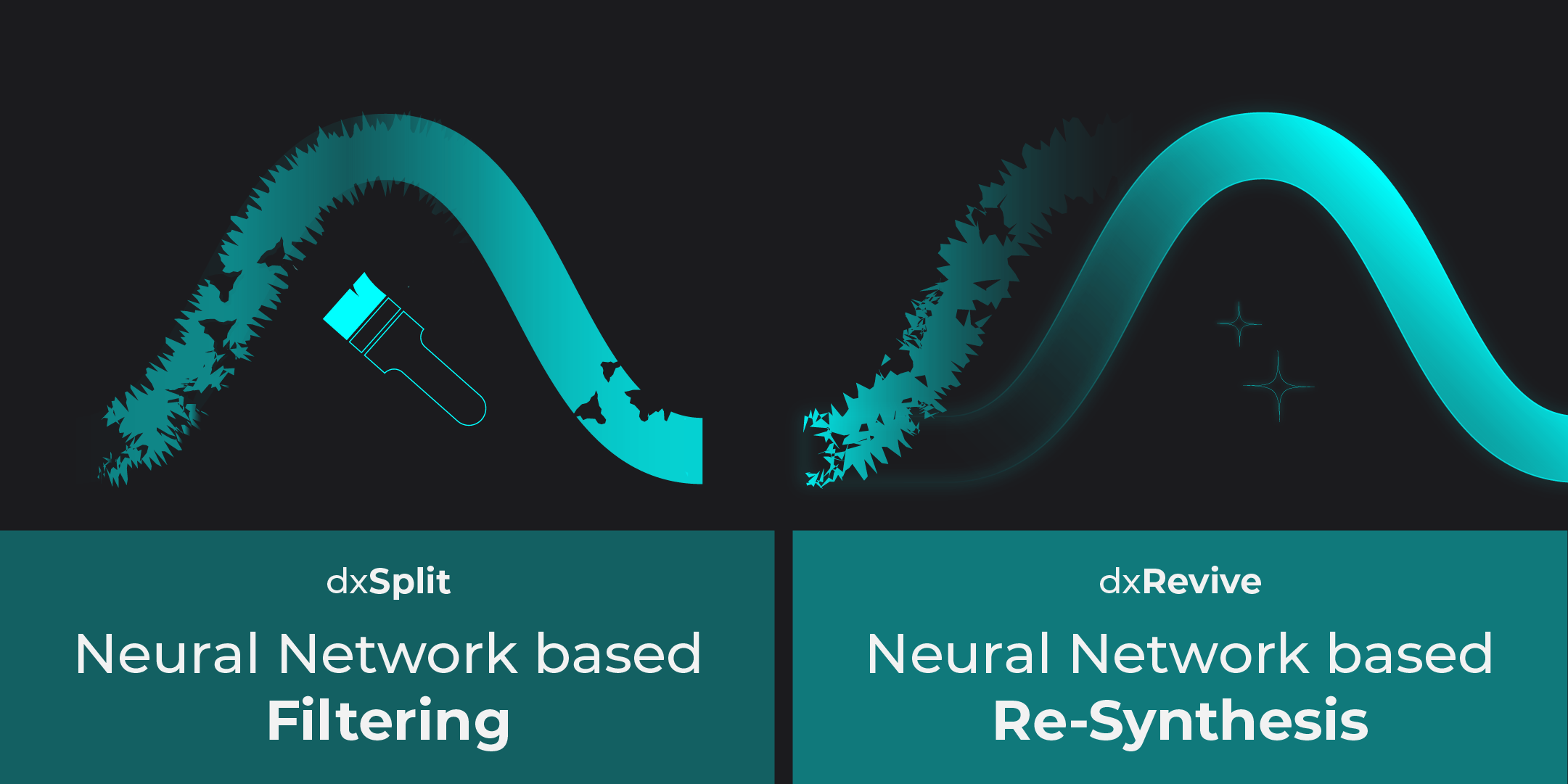
This is exactly where dxSplit and dxRevive diverge. Think of a damaged audio recording like an ancient artifact buried in dirt:
dxSplit works like an archaeologist carefully removing layers of soil — brushing away noise and reverb until the original object becomes visible again.
dxRevive, on the other hand, goes a step further.
If parts of the artifact are missing or broken, it acts like a restoration expert who models a flawless replica of the original artifact.
In other words: One reveals what’s already there. The other rebuilds what’s gone.
dxSplit: Reveal what’s there
dxSplit is based on a separation approach. In simple terms, it attempts to break a recording into its components by isolating dialogue from background noise and reverb. It basically operates as three time varying filters.
The audio is not recreated, but rather extracted and cleaned from the existing signal. That’s why dxSplit is basically a filter, eventhough the seperation itself is carried out by machine learning.
Strengths:
- Preserves the original voice characteristics
- Natural-sounding results
- Ideal for moderately clean dialogue recordings
Limitations:
- Relies on the presence of usable speech in the signal
- Cannot fully recover severely degraded or missing speech information
Key idea of dxSplit: “Reveal what’s there”
dxRevive integration for dxSplit
dxRevive: Recreate what’s missing
dxRevive takes a fundamentally different approach: Instead of only isolating speech, it performs re-synthesis. This means the system analyzes the degraded input and then reconstructs a clean version of the speech signal based on learned patterns.
This represents a paradigm shift, turning dxRevive into the first post production plugin following this approach.
Strengths:
- Can recover heavily degraded or distorted dialogue
- Works even when speech is barely intelligible
- Significantly improves clarity in extreme cases
Trade-offs:
- The output is no longer a pure version of the original signal
- Subtle changes in voice character may occur
Key idea of dxRevive: “Recreate what’s missing”
When to use which tool
Choosing between dxSplit and dxRevive depends largely on the condition of your audio:
Use dxSplit when:
- Speech is clearly present but mixed with noise and/or reverb
- You want to preserve the original voice as much as possible
- The recording quality is decent to moderately degraded
Use dxRevive when:
- The recording is severely degraded
- Speech is difficult to understand
- Maximum intelligibility is more important than perfect authenticity
Get the Restoration Bundle and SAVE 16%
Optimize your Workflow with dxSplit and dxRevive Pro.
How to combine dxSplit and dxRevive
We’ve learned that both plugins have their own unique strengths:
dxSplit provides separate control over voice, reverb, and noise components, allowing you to reduce or boost each one by the desired amount.
dxRevive restores missing or damaged frequencies within the speech signal itself.
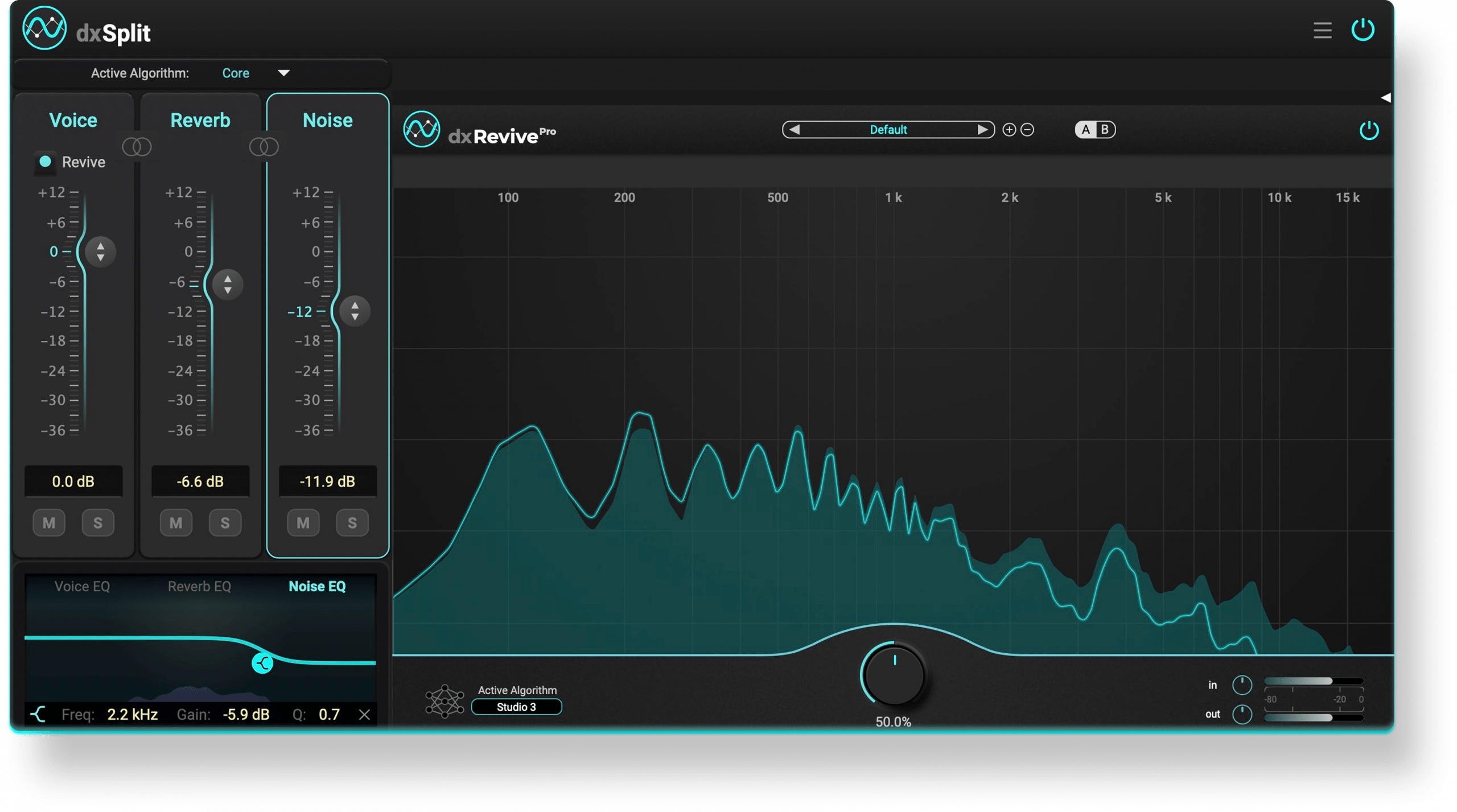
It therefore makes perfect sense to combine these strengths by using both plugins together. One way to do this is to load dxRevive directly inside dxSplit and apply it only to the voice component. With this setup, you can modify all signal components separately in dxSplit, while the restoration power of dxRevive is applied exclusively to the voice component. The processed voice signal is then mixed back together with reverb and noise at the final stage.
Learn more about setting up both plugins in this tutorial:

Conclusion
dxSplit and dxRevive address similar problems — but solve them in fundamentally different ways:
While dxSplit isolates and filters existing speech, dxRevive is capable of reconstructing it entirely.
As audio post-production continues to evolve, this distinction becomes increasingly important — marking a shift from traditional enhancement toward generative audio processing.